UN
UN
Executive Summary
While the world attempts to accelerate the transition toward sustainable development, armed conflicts are silently undoing decades of environmental progress. Wars not only destroy cities and infrastructure but also damage ecosystems, accelerate carbon emissions, contaminate soil and water, and divert global financial resources away from climate solutions.
Recent conflicts—from Eastern Europe to the Middle East and parts of Africa—demonstrate that modern warfare has become one of the most underestimated drivers of environmental degradation.
For sustainability experts, war represents a systemic shock to the global sustainability agenda, directly threatening multiple UN Sustainable Development Goals (SDGs).
1. The Carbon Footprint of War
Military operations are among the largest institutional consumers of fossil fuels.
Fighter jets, tanks, naval fleets, and military logistics require enormous energy inputs. Studies estimate that the global military sector accounts for roughly 5–6% of total global greenhouse gas emissions if indirect supply chains are included.
A single hour of flight for a modern fighter jet can emit as much carbon as several cars produce in an entire year.
In addition to direct emissions, wars create massive secondary emissions through reconstruction efforts, burning infrastructure, and damaged industrial facilities.
2. Ecosystem Destruction
War zones often become large-scale ecological disaster areas.
Explosions, artillery strikes, and land mines devastate forests, wetlands, and agricultural lands. Wildlife habitats are fragmented or permanently destroyed.
For example:
• Agricultural land becomes unusable due to unexploded ordnance
• Forest fires triggered by bombardments spread uncontrollably
• Protected natural reserves become military zones
In some cases, ecosystems may take decades or even centuries to recover.
3. Soil and Water Contamination
Modern weapons introduce heavy metals and toxic chemicals into the environment.
Battlefields often contain residues of:
- lead
- mercury
- depleted uranium
- explosive chemicals such as TNT and RDX
These substances contaminate soil and groundwater, creating long-term environmental and public health risks.
In agricultural regions, contaminated soil can reduce food production for years.
4. War and Energy Dependency
Conflicts often disrupt global energy markets, triggering increased reliance on fossil fuels.
For example, geopolitical instability can delay renewable energy investments and push countries to reopen coal plants or increase oil extraction to maintain energy security.
As a result, wars indirectly slow down the global clean-energy transition.
5. Climate Finance Gets Redirected
Another overlooked consequence of war is the diversion of financial resources.
Governments facing security threats dramatically increase military spending, while climate adaptation and sustainability programs often lose funding.
In recent years, global military spending has surpassed 2.4 trillion dollars annually, a figure that dwarfs many climate investment programs.
This shift weakens global capacity to address climate change.
6. Threats to Global Food Security
War disrupts agriculture, supply chains, and fertilizer production.
Conflict zones frequently experience:
- destroyed farmland
- damaged irrigation systems
- blocked export routes
These disruptions can cause global food price spikes and worsen hunger in vulnerable regions.
7. Sustainability and Peace: An Emerging Policy Debate
Experts increasingly argue that peace and sustainability are deeply interconnected.
Without political stability, it becomes extremely difficult to achieve climate targets, protect biodiversity, or implement long-term environmental policies.
For this reason, some researchers now frame peace as a “precondition for sustainable development.”
Conclusion
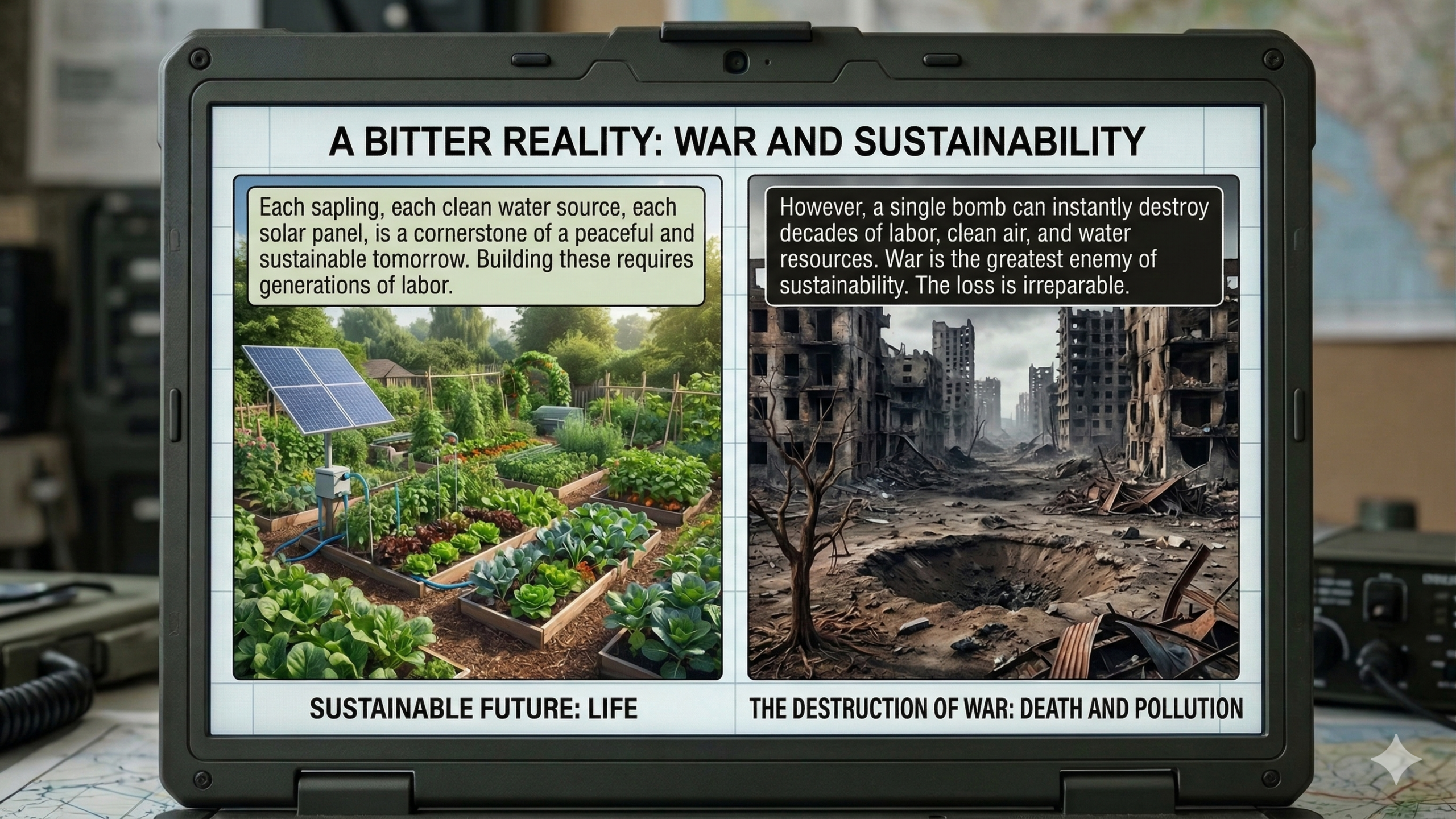
War is not only a humanitarian tragedy; it is also an environmental crisis.
Every missile launched, every forest burned, and every industrial facility destroyed pushes the world further away from its sustainability goals.
If the global community aims to achieve climate neutrality and protect ecosystems, addressing the environmental impacts of armed conflict must become part of the sustainability conversation.
Peace, in this sense, may be one of the most powerful climate policies humanity has.