UN
UN
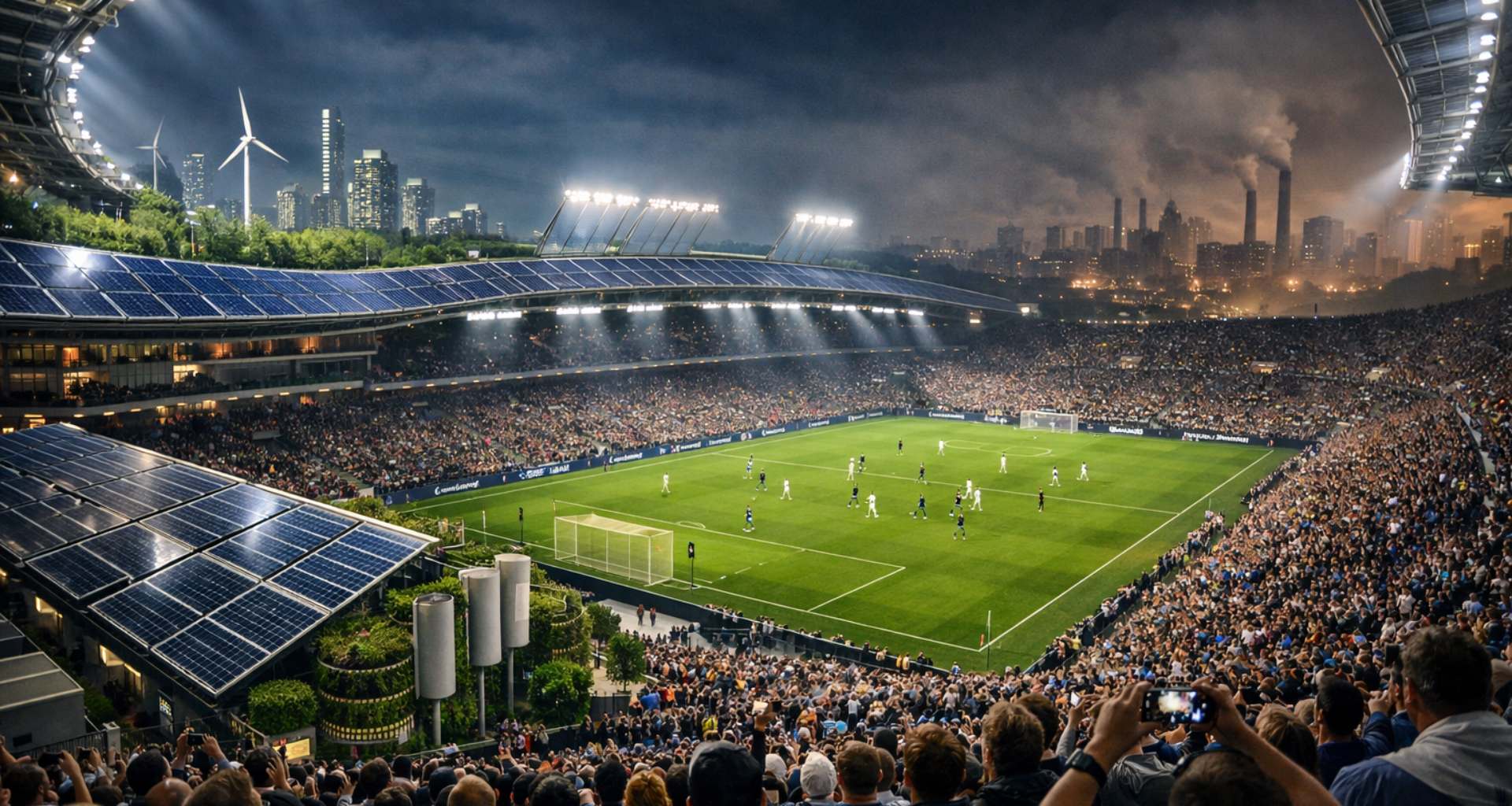

Football can make everything else disappear
Football has always been more than a game. It is emotion, identity and, at times, an escape from reality. Inside a full stadium, with the atmosphere peaking and the match carrying everyone forward, almost nobody is thinking about aircraft emissions, construction materials or electricity demand. That is part of football’s power. It can make the outside world disappear for 90 minutes.
But global sport no longer operates outside the climate conversation. The bigger the event, the harder it is to ignore the footprint that sits behind the spectacle.
The World Cup sustainability test
FIFA placed sustainability at the centre of the 2022 FIFA World Cup in Qatar and presented the tournament as carbon neutral. The official framing highlighted solar-powered venues, modular stadium design and more efficient transport systems. On paper, that looked like a major step for a tournament of that scale.
FIFA’s sustainability reporting estimated the tournament’s total footprint at roughly 3.6 million tonnes of CO2 equivalent and argued that the remaining emissions could be offset. That position helped define the tournament’s public climate narrative.
Why critics said the claim went too far
The strongest criticism was not that football should ignore sustainability, but that carbon-neutral branding can hide the difference between reducing emissions and compensating for them. Environmental groups and watchdogs argued that offsets did not erase the real climate cost of flights, cooling, construction and event operations.
That criticism became more concrete in 2023, when Carbon Market Watch said regulators had effectively rejected FIFA’s carbon-neutral advertising claim. The core issue was credibility: whether the accounting behind the headline matched the real world impact.
This is the contradiction modern sport now faces. Fans experience joy, intensity and belonging. The planet absorbs the logistical burden that makes the experience possible.
The fan perspective is the point
From a fan’s perspective, everything can feel perfect. The stadium is alive, the city is moving, the tournament appears seamless. Yet that seamlessness is built on a heavy industrial and transport system.
Thousands of international flights, large-scale venue development, high cooling demand and complex supply chains do not disappear simply because the event feels magical in the moment. Football does what it does best: it narrows attention to the match itself. Sustainability asks us to widen the frame again.
Zero-emission football is not here yet
A zero-emission World Cup is not a realistic description of the current global game. The challenge is too large, especially for tournaments that depend on long-distance travel, high-consumption broadcasting infrastructure and years of physical preparation.
That does not mean the effort is meaningless. It means the standard must become stricter. Public expectations are changing. Saying an event is green, sustainable or carbon neutral is no longer enough on its own. Audiences want transparent methods, defensible numbers and evidence of actual reductions.
What football will be judged on next
The real question is not whether global sport can become impact-free overnight. It cannot. The real question is whether governing bodies are trying to change the system or mainly trying to improve the optics around it.
FIFA says it will pursue more ambitious sustainability targets in the years ahead. That promise matters, but so does the quality of the proof behind it. Football may still be judged by goals, trophies and atmosphere first. Increasingly, though, it is also being judged by the footprint it leaves behind.
Sources
- FIFA, sustainability reporting and Qatar 2022 climate claims
- Carbon Market Watch, criticism of the carbon-neutral advertising claim